 Are you ready to discover a city full of history and tradition? Gyeongju is a Korean city that has maintained its splendour since the 7th century, when it was the capital of the Silla Kingdom.
In the following guide we will show you all the treasures of this ancient capital: temples, historical sites, natural parks, museums and much more.
Our favourite city in South Korea is an ideal destination for lovers of history, culture, architecture and scenery. The places you'll find here are unique in the world.
Pack your suitcase for an unforgettable adventure, because we're going to show you the must-see and must-do things to do in Gyeongju.
How to get to Gyeongju?

Cheomseongdae Observatory in Gyeongju
Gyeongju is a city located in Gyeongsangbuk-do Province in southeastern South Korea. This historic city is full of temples, archaeological sites and museums. If you are in Seoul and want to visit this city, there are several ways to get to this tourist destination.
Book your hotel, discount, free cancellation
In preparation for your trip, book your hotel now on booking.com with with discounts and possible free cancellation.
Here you can book your hotel.
The quickest way to get there is to take a flight from Incheon International Airport to Gyeongju Airport, just 20 minutes from the city. Flights have a flight time of approximately one hour. Once you arrive at the airport, you can take a bus or taxi into the city.
Another way is to take the train, which is what we did. The KTX high-speed train will take you from Seoul to Gyeongju Station in about 2 hours.
You can also take a bus from Seoul to Gyeongju. If you decide to take this mode of travel, the journey can take 2 to 3 hours, depending on the time of day.
Regardless of how you choose to get there, it's important to take into account where you'll be staying during your trip. If you're starting your journey from Seoul and looking for accommodations in the Mapo-gu district, you can find a variety of options https://www.seoulhotelspage.com/en/near-mapo-gu-dr284094/.
We help you travel cheaper!
BOOK HERE THE BEST HOTELS for your trip AT THE BEST PRICE.
NO QUEUES, NO WAITING, the best EXCURSIONS AND GUIDED TOURS.
MOVE AT YOUR OWN FINGER and save A BIG PENNY on your CAR RENTAL booking.
Practical tips for your first trip to South Korea:
We always travel abroad with travel insurance to be protected in case of illness or accident. That is why we recommend take out the IATI Seguros travel insurance here and just for being a reader of el Pachinko you get a 5% discount..
And to check how to get from one destination to another on Google Maps, look for reviews of a hotel, restaurant or excursion, stay in direct contact with our family or friends via WhatsApp, or share photos and videos on Instagram or Tik Tok from South Korea we recommend you the Holafly eSIM card.
What to see in Gyeongju?
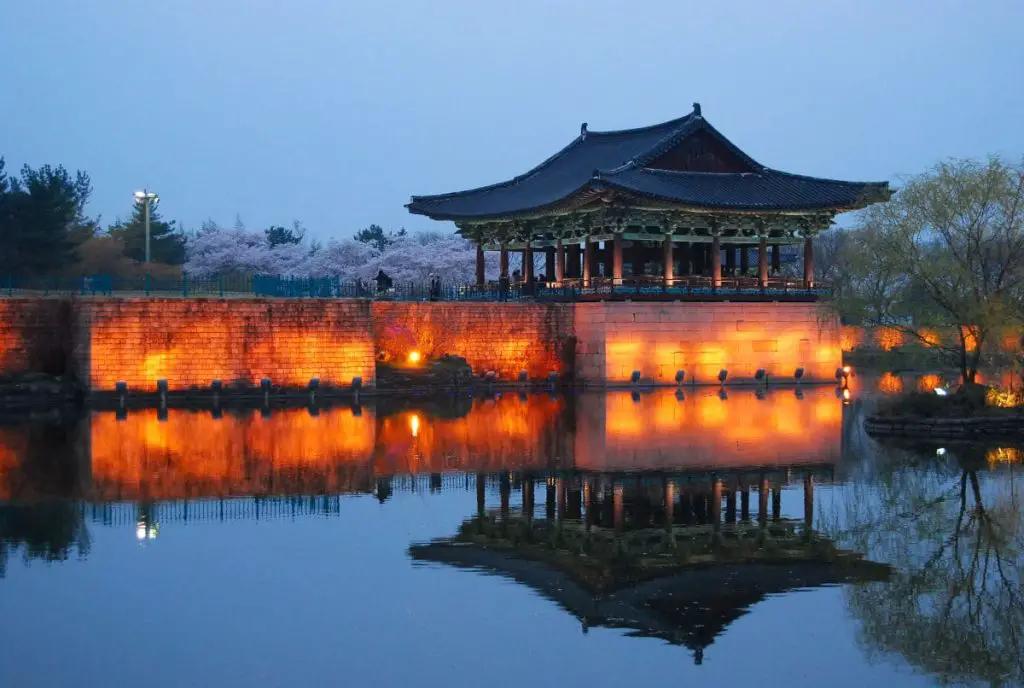
Gyeongju Anapji Pond
This city is known for its many historical sites and for being the home of the Silla dynasty between 57 BC and 935 AD. This city offers visitors a variety of destinations to explore: from ancient temples and gardens to modern amusement parks. Here are some of the most important sites to see in Gyeongju.
Burial Mounds
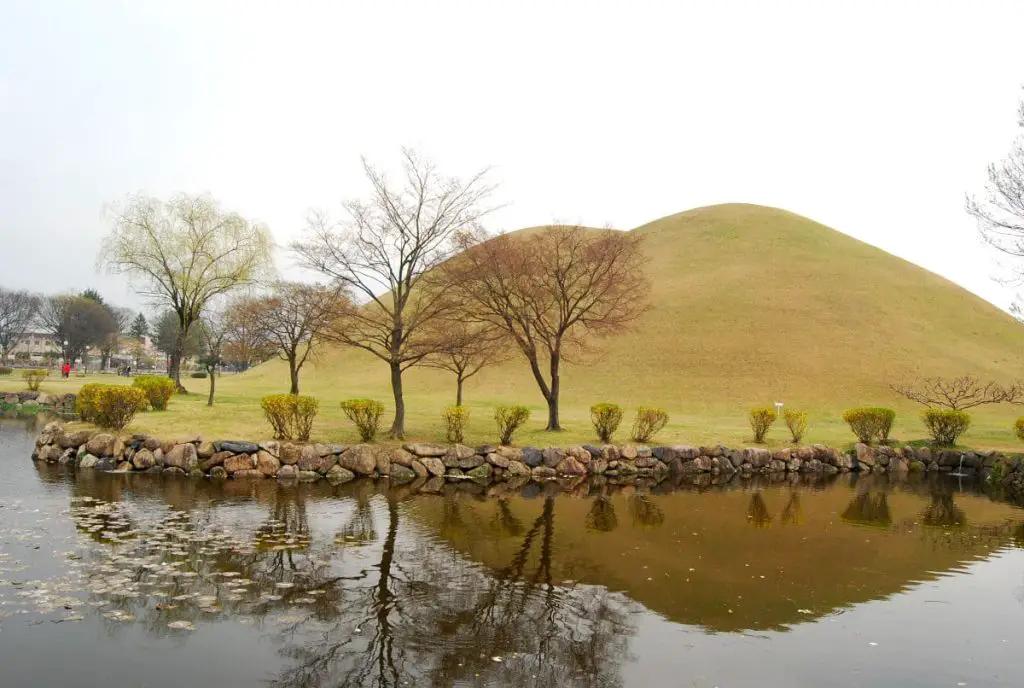
Gyeongju Burial Mounds Park
Gyeongju' s burial mounds are known as one of the finest examples of Goryeo Dynasty architecture. The city is home to hundreds of tombs, each designed to represent the life of the person buried there.
These are located in the oldest part of the city, in an area known as the Gyeongju Burial Mound Park..
They were built between the 9th and 14th centuries and are said to have housed the most important members of the Goryeo dynasty.
They were built with bricks and covered with a stone slab. Each tomb was decorated with engravings depicting the life of the deceased. Many of them are still in good condition and can be visited by tourists.
Cheomseongdae Observatory

Cheomseongdae Observatory In Gyeongju
Cheomseongdae Observatory is a stone structure built during the Silla period between 751 and 774 AD. Although its original function was astronomical, today it is one of the city's main tourist attractions.
Cheomseongdae was built in a circular shape. The structure is composed of 362 stone blocks and is believed to have been built to measure the movements of the stars and to study the sky.
Scholars of the time believed that the stars influenced human life. There are many legends about the origin of this construction. One of the best known is that a queen of the Silla dynasty almost died, but was miraculously saved by the magic of a star. In gratitude, she decided to build the observatory.
Cheomseongdae, besides being an important historical heritage site, is also an important archaeological site. Archaeologists have discovered numerous ancient artefacts in the structure, including pottery, weapons and statues.
Gyeongju Gyochon Traditional Village
Gyeongju Gyochon Traditional Village is a traditional village of historical interest. It consists of 100 traditional houses, some of which have been restored for use as museums, restaurants and shops.
Most of the houses were built in the 18th century and retain the old designs and styles of that era. The village also boasts a wealth of traditional gardens, trees and shrubs, as well as stone ponds and pools.
Visitors can enjoy a variety of activities such as visiting museums, sampling local food and enjoying music and dance performances. The village also boasts a wealth of historical monuments, such as temples and tombs.
Woljeonggyo Bridge
Woljeonggyo Bridge is a bridge over the Yeongjucheon River, north of the Bulguk-sa and Seokguram temple area. The bridge is one of the wonders of Korea and is known for its unique and attractive architecture. It is believed to have been built during the reign of King Heungdeok of the Silla Dynasty in 814.
It was built of limestone and is 114 metres long. It consists of ten connected stone arches, each of which is about 4.5 metres high. It is flanked by two wooden posts on either side. These posts date back to the 16th century, when the bridge was rebuilt.
The bridge has largely remained in its original state, even after years of heavy use. Today, it is a popular tourist destination. The moonlight over the bridge provides a unique and beautiful view at night.
Seongdong Market
Seongdong Market is one of the most important markets in the city. It offers a wide variety of local products, from food to handicrafts. It has remained a key point for local culture for many years.
Visitors can find a variety of traditional foods, such as tteokbokki (rice with spicy sauce), hodduk (a pastry filled with sugar and rice flour) and japchae (sweet potato noodles). There is also a large selection of handmade crafts, such as traditional dresses, jewellery and decorative items.
Seongdong Market is a very welcoming place where visitors can experience the local culture first hand. The vendors are friendly and always willing to help visitors. You can also enjoy a wide variety of entertainment, including traditional music and local performances.
Bulguksa Temple

Gyeongju Bulguksa Temple
The Bulguksa Buddhist Temple is one of Korea's most important World Heritage Sites and one of the oldest temples. It was built in the 8th century, during the Silla reign. It is a place that stands out for its architecture and gardens.
It consists of two main halls: Daeungjeon and Geungnakjeon. These halls are separated by a marble staircase known as Cheongungyo. The main hall, Daeungjeon, is the main temple and is visited by believers. It is decorated with Buddha statues and surrounded by several statues of devas.
There are also several secondary structures such as Chilbo Temple, Seokgatap Temple, Dabotap Temple and Beomyeongnu Temple. These are surrounded by gardens and decorated with statues of Buddha and other characters from Buddhist mythology.
This is a place of pilgrimage for Buddhists. Many believers visit the temple to pray and meditate. Religious ceremonies are also held to celebrate the new year.
Seokguram Grotto
Seokguram Grotto is an ancient Buddhist structure located in Bulguksa Temple. It has been on the UNESCO World Heritage List since 1995 and is one of the country's top tourist destinations. It was built between 751 and 774 during the Silla Dynasty period.
The grotto is located on top of a granite hill and faces east to let in the sunrise light. The design of the grotto is unique. It is decorated with a wide variety of designs, from lotus flowers to dragons.
The Seokguram Buddha is located inside the grotto on a marble platform. He is seated in a meditation posture with his hands in the lotus position. The artists who created the Seokguram Buddha used advanced techniques to achieve a three-dimensional effect.
The Seokguram Grotto is also famous for its striking mosaics and reliefs. They are made of stone and cover most of the grotto. They are highly detailed and depict the various Buddhist gods.
Yandong Village
Yandong Village is located about 8 km from Gyeongju City and is known as one of the most typical villages in the area. It has remained virtually unchanged for over a thousand years.
During the Silla Dynasty (57 BC - 935 AD), it was the place where royal officials gathered to hold councils. This is because it houses some of the oldest temples in the region. The Bulguksa Temple, mentioned above, is one of the oldest temples in Korea.
It is also known for its beautiful nature. Visitors can enjoy the local flora and fauna while walking along the village trails.
Some of Korea's most interesting traditions can be found in Yandong Village. There are a variety of workshops, such as bamboo basket making and dyed scarf making. There are also many traditional food restaurants serving dishes typical of the region.
Anapji Pond
Gyeonju' s Anapji Pond is a beautiful complex that was part of the Wolseung Royal Fortress, built more than 13 centuries ago on the orders of King Munmu with more than admirable results.
Dozens of brightly coloured fish swim here, playing with the reflections of the pointed roofs or hiding in the hollows of strategically placed stones to create a perfect harmony of the elements. It is almost impossible not to be moved in such a place.
How to get around Gyeonju?

Cherry Blossoms In Gyeongju
If you want to get around the city, there are several transportation options available.
Taxi: Taxis are a convenient way to get around the city. The price of a taxi is around 2,500 won per km. The price varies depending on the distance travelled.
Bus: Buses are a cheaper option for getting around. There are many bus lines connecting the city with other places. The price depends on the route, but in general is around 1,200 won.
Bicycle rental: Renting a bicycle is a fun way to explore the city. There are several bike rental companies. The hourly rate is around 4,000 won. There are also daily rates starting at 15,000 won.
Train: There is also a train line connecting Gyeonju with other places. The price of a train ticket varies depending on the distance travelled. The shortest section costs around 1,000 won.
Where to eat in Gyeonju?

Typical Korean Dish
If you visit this city, you can't miss out on the delicious local food offered in the city's restaurants. Here are some of the best places to eat in Gyeonju:
Myeongga: this Korean-style restaurant offers a variety of typical Gyeonju dishes, such as bulgogi and bibimbap. Portions are generous and prices are affordable. The restaurant also offers excellent customer service.
Gyeonju Korean BBQ: This restaurant is very popular among tourists, as they serve traditional dishes such as "ssam". This is a meal based on grilled meat with vegetables. The food is fresh and tasty, and the price is reasonable.
San Gyeonju: This restaurant offers a variety of Korean dishes, from sushi to grilled dishes. They are very tasty and the prices are affordable. The restaurant is nicely decorated and offers a pleasant atmosphere.
Gyeonju Kimchi: This restaurant is famous for its kimchi dishes. They offer a variety of kimchi dishes such as kimchi jjigae and kimchi bokkeumbap. The prices are reasonable and the food is very tasty.
Gyeonju Noodle House: This noodle house offers a variety of noodle dishes, such as jjajangmyeon and kalguksu. The dishes are very tasty and the prices are affordable. The restaurant is very cosy and offers a warm atmosphere.
Where to sleep in Gyeonju?
 If you are planning to visit Gyeonju, there are a few places to stay that may satisfy your interest.
Firstly, the Hilton Gyeongju is an excellent choice for those who want to enjoy a luxury experience. It is located in the heart of the city. It offers spectacular views and excellent facilities. This is an expensive option, but it is definitely worth it. This is the one we chose after ruling out the hanok.
Another excellent option is the Gyeongju Tourist Guesthouse, a small and cosy inn located within walking distance of the centre. The hostel is very clean and offers modern facilities for its guests. It also offers a variety of fun activities and a relaxed atmosphere to enjoy.